
Tourists’ habits change from year to year. The former traditional two-week vacations that guests spend in the same place, choosing sun and sea destinations, going to the same beach and having dinner at the same restaurant, are no longer fashionable and do not achieve the desired economic results. Guests are now eager for as many activities as possible in the shortest amount of time, so they stay at one destination for a very short time.
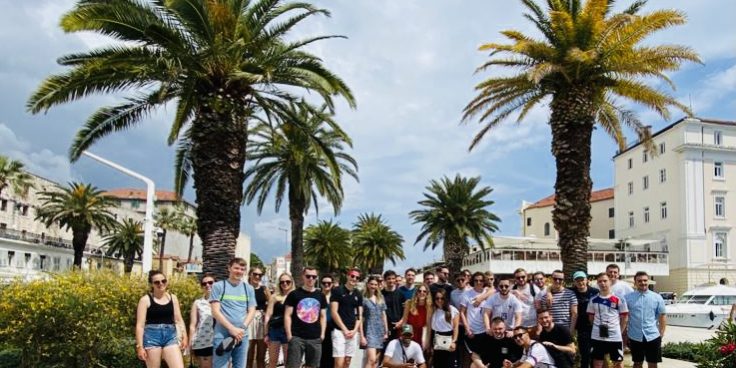
How to attract as many guests as possible for as long time as possible and ensure the prosperity of the community in such changed conditions? Perhaps the answer lies in selective forms of tourism, one of them being education. This was the model that Aspira applied by organizing a two-week stay for 57 young French people accompanied by 4 professors who arrived in our city from AMOS Sport Business School in France as part of their regular study program. Students came from four of the 12 campuses that AMOS has throughout France: from Paris, Lyon, Bordeaux and London in France, and during two weeks of their study trip they had various academic obligations, but also fun activities. Apart from acquiring new knowledge, they got to spend more time than usual in our city. They combined business and pleasure, all in favor of our tourism sector.
What exactly is it about?
In the academic part of their study trip to Aspira, for which they receive ECTS credits, they had the opportunity to listen to lectures on sports journalism, history of Croatian sports, organization of major sports organizations, as well as personal stories and experiences of professional Croatian athletes in handball, water polo and mountaineering. It was, of course, a great opportunity to promote sport in Split because the city under Marjan, given the number of inhabitants and the successes that its athletes have achieved worldwide, is ‘the most sporting city in the world’. Basketball, football, tennis, athletics, martial arts, rowing, sailing, water polo, handball… to list at least some of them. And French students got to see, learn and discover everything about it from the first hand.
Of course, apart from learning, the students had the opportunity to enjoy Split as tourists with a tour guide, walk and hike Marjan, visit the Poljud Stadium, enjoy a workshop where they cooked traditional Dalmatian dishes in modernly equipped Aspira’s kitchen practicum as well as attend sommelier workshop. It would be a sin to come to Split and not see picigin on Bačvice, the ideal combination of activities and rest and the best insight into the life of the locals, enjoy some canyoning on the River Cetina with lunch – traditional peka, visit beautiful Šibenik and Krka National Park, train water polo at Poljud pools, see the Spaladium arena… Many unforgettable experiences for Aspira’s guests, but at the same time an innovative business move, not only for Split tourism, but also for the cities in its vicinity.
The French students were extremely pleased with the organization of their stay in Split.
Twenty-two-year-old Margaux Thompson from Paris said:
– This is my first visit to Croatia, it was wonderful to see the sea and the city, I didn’t even know how historically rich it is. I am impressed by its mix of modern architecture and the old part of the city. City life is also exciting, it is wonderful to feel life again and have the opportunity to travel. We climbed Marjan, enjoyed unforgettable canyoning on the River Cetina, saw the National Park Krka. Split is surrounded by so different and so beautiful landscapes. And we have them in France, but not to that extent.
Her peer and colleague from Lyon, Maxime Ragot also had pleasurable experience:
– I think that Croatia is very passionate about sports. It is such a small country, with a small population, but has so many achievements in different sports! Croats are proud of their history, which I think is among the richest in Europe and I am very glad that I had the opportunity to be here. Also, I notice that everyone in Split is connected with Hajduk, which is wonderful for me. It’s a completely different perspective than the one we have in France.
– Dean of Aspira College, Alen Jerkunica, commented:
– I am extremely glad that the French students are satisfied with their stay in Aspira and the city of Split. They stayed here for two weeks, which is really worth noting if we take into account that the average tourist in our city does not stay longer than 3 days. With their arrival, this group of young people benefited the whole community, paid for their accommodation, visited many cultural, sports and catering facilities, and most importantly – they returned home full of positive impressions and ready to promote the city to their acquaintances.
Now, in the situation when we must do more to stimulate more profitable results, the sector of tourism on the one hand and us, educational institutions that provide quality staff in tourism, on the other hand, I think that educational tourism has a very great potential and it is the right direction to follow. Looking at the situation at the European level, Germany has the largest number of foreign students – 23% who have been confirmed to behave like tourists in a receptive destination, consume tourist content and contribute to development of tourism sector. Also, it is interesting that Luxembourg has as many as 47% of foreign students, and Cyprus as many as 23%. On the other hand, Croatia is at the very bottom of the European scale. According to Eurostat data for 2020, the share of foreign students in the total number of students in Croatia is the lowest in Europe. This is very bad and I think it is time for change because if we do not do it, this potential will surely be used by someone else.
There is a lot of room for improvement, and Aspira showed how important such initiatives are in the process of promoting Croatia as a tourist destination as well as in the business segment of the tourism sector, which is still in the process of recovering from the coronacrisis that stopped its development and forced stagnation. With an excellent program by Aspira, but also the fun activities they enjoyed during the stay, it is to be expected that in the future some of the students who now came to Split will again choose Croatia as their tourist destination.