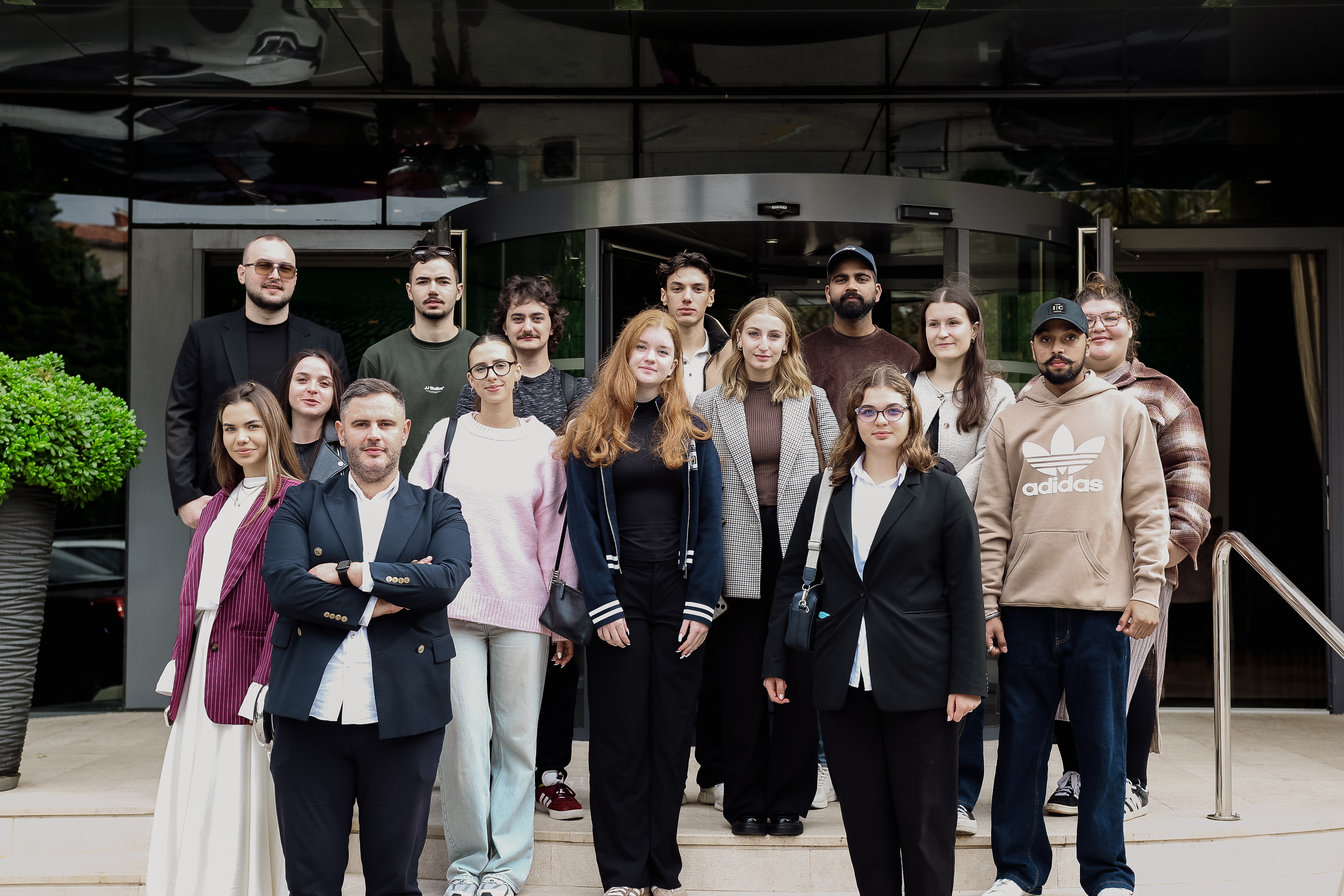
Our study program is created in cooperation with the employers

For more than a decade, Aspira’s International Hospitality and Tourism Management undergraduate program has been preparing students for management careers in the tourism, hospitality and hotel industries.


According to The World Travel and Tourism Council (WTTC), tourism accounts for more than 10% of global GDP and generates more than 20% of all employment. Recognizing the increased demand for highly-qualified professionals and the ever-changing nature of tourism, our expert faculty has created curricula that focus on three specialized fields of study:  DMC—Destination Management of Organizations and Companies, Hotel Management and Gastronomy.

Implemented in accordance with the internationally recognized (48 countries), rigorous educational standards of the Bologna process, each program takes three years to complete and has two semesters per year.  In the third semester, students can choose their specialty. The sixth semester is entirely dedicated to on-site, practical training.

Who is the study program intended for

Professional undergraduate study in International Hospitality and Tourism Management at  Aspira University of Applied Sciences is intended for those who wish to be educated for managing functions in tourism and hotel industry, as well as those who are already employed, but want to improve the existing and acquire new knowledge and skills.
Tourism is without any doubt one of the most promising industries in the world, and for many countries it is an important export product as well as an employment generator. Nowadays, tourism is a social and economic fact which is an indispensable part of modern civilization in the international community. Tourism is one of the general characteristics of the times we live in.

The history of tourism shows that systematic planning is one of the decisive factors for the development of tourism adapted to the needs of tourists and the receptive community, and management in tourism is a special concept and a way of managing business activities which enables achieving satisfaction of tourist customers, as well as realization of revenues and other objectives.

Education and training are the key resources of modern business and its development, thus an adequate training of staff in the hotel industry and tourism is a precondition for competitive advantages of a particular community, raising productivity and increasing market value

Education objective

The objective of the study program of International Hospitality and Tourism Management is qualitative improvement of professionals to work in the hotel industry and tourism by introducing new and additional knowledge and skills through specializations. Specialization is organized so that students after finishing the second semester choose in the third semester between two fields of study, namely: Hotel Management and Management of Destination Organizations (DMO) and Companies (DMC). This kind of specialization provides students with knowledge which is applicable and required in the labor market, and which is relevant in the international context.

Students will be competent to do management and administrative work in: tourist boards, travel agencies, associations, tourist associations, departments of tourism in city governments, departments of tourism in the County, the Department of Tourism at Ministry of Tourism, hotel facilities, business systems, event management companies, marketing agencies, marketing communication agencies, marketing management departments, consulting companies, and other; as well as in general; managing companies in different branches of economy, trading, etc.

Specialized Fields of Study

Hotel Management

The study program of Hotel Management, with the help of top experts and academic lecturers with rich expertise and experience. The main objectives of this program are: individualized work in small groups with a direct mentoring supervision by assistants and teachers; high level of vertical and horizontal student mobility; a large number of elective courses that students may choose at any other higher education institution.

Destination Management Organizations (DMO) and Destination Management Companies (DMC)

For the sustainable development of modern tourism, key intermediaries are those that are connecting the supply with demand. Destination Management Organizations (DMO) are of a public character and aim at managing destination development, marketing of destinations, as well as fostering cooperation between the public and private sector.

GASTRONOMY

Thanks to its unique culinary offer, Croatia is quickly becoming one of the top gastronomic regions. The study program of Gastronomy will teach you everything about cooking, restaurant and kitchen management. Our international and local top chefs and gastronomy experts will pave the way for all the challenges in your culinary career.

Duration of the study program

The study program lasts for 3 years (6 semesters), and it is implemented both as full-time and part-time study program. After finishing the study program of International Hospitality and Tourism Management students obtain, under the provisions of the Bologna process, at least 180 ECTS credits and the professional title of:

Bachelor of International Hospitality and Tourism Management (B. Econ.)

Learning outcome for the study program

The anticipated learning outcomes achieved by the completion of this professional study will enable students the following competencies:

  • to recognize the significance and role of tourism on a national and inter-national basis (from the aspect of the whole society and the individual)
  • Create a unique tourist product and place it on the international consumer market
  • Communicate appropriately in Croatian and foreign languages with stakeholders in the tourist destination
  • Apply managerial functions and techniques in tourism and methods of managerial forecasting
  • Combine applied mathematical and statistical methods for making strategic business decisions
  • Use modern IT technologies in business
  • Identify the importance of gastronomy and oenology in creating a complete tourist experience
  • To value the history of cooking and modern culinary trends and use cooking and restaurateur techniques when preparing and cooking different dishes
  • Apply the basic principles of sanitation and food hygiene when working in the kitchen and food and beverage department
  • Recognize the principles of kitchen management in the business of a food and beverage department or an independent restaurant
  • To value the potential of constant development of human traits, abilities and motor skills through physical activity and proper nutrition and keeping them at the highest possible level for as long as possible
  • Valorize the cultural heritage and its geographical distribution for the purpose of creating a plan for the tourist offer of the destination
  • Shape the tourist offer based on established needs and demands, as well as tourist resources and attractions
  • Conduct market research while creating an effective marketing strategy and plans for the implementation and control of business goals and activities in tourism
  • Create a financial plan for a tourist organization or company
  • Valorize the principles of sustainable development as fundamental conditions for the development and preservation of a tourist destination and recognize the positive and negative effects of tourism development in different types of tourism
  • Apply the methods of sales and reception business in the hotel
  • Apply legal acts and laws in international tourism business
  • Manage human resources in hotels and tourist destinations
  • Apply the principles of international transactions of products, services, capital and labor, solve practical cases and problems from the real business world
  • to apply the principles of international transaction of products, services, capital and labor, solving practical cases and problems from a real business world

Semester overview

Semester I

Principles of Economics
Basics of International Tourism
Computer Science
Business Communication in the International Market
Business English I
Physical Education I
Croatian Language I

Semester II

Business Mathematics
International Management
International Marketing in Tourism
Management of Selective Forms of Tourism
Business English II
Physical Education II

Croatian Language II
Internship I

Semester III

Principles of Accounting (T)
Development of Destination Management Organizations (DMO&DMK)
International Hotel Management (HM)
Food and Beverage Management (HM)
International Trade Law
Business StatisticsBusiness English III (T)
Croatian Language III
Physical Education III
Optional course: Foreign Language I

Semester IV

Entrepreneurship in Hospitality and Tourism
Economics of International Hospitality and Tourism
World Cultural Heritage and Tourism (DMO&DMK)
Tourist Geography
Business English IV (T)
Croatian Language IV
Physical Education IV
Internship II (T)
Optional course: Foreign Language II

Semester V

Sales And Front Office Operations
Sustainable Development and Transformative Tourism of the Future
Human Resource Management (T)
ELECTIVE**
ELECTIVE**

Semester VI

Internship III / Business Project in Tourism
Graduation Thesis

List of elective courses

International Destination Management Companies
Internet Marketing
Nautical Tourism
Financial Management
Event Management
Business Foreign Language I

Semester V

International Destination Management
Companies

Sustainable Development and Transformative Tourism of the Future

Human Resource Management (T)

ELECTIVE**
ELECTIVE**

Semester VI

Internship III / Business Project in Tourism
Graduation Thesis

List of elective courses

Sales And Front Office Operations
Internet marketing
Nautical Tourism
Financial Management

Event Management
Business Foreign Language I

Why study at Aspira

ACCOMPLISHING INTERNATIONAL CAREER IN TOURISM

A large number of foreign lecturers who have a significant scientific and professional career are involved in the study program and are ready to share their experiences with the students. In addition, through numerous guest lectures, students get familiar with rich examples of everyday practice that can significantly contribute to their future business. Students are offered the option of attending professional practice in numerous world hotels and organizations, thus gaining top practical experience first hand. Knowledge gained at Aspira University of Applied Sciences enables work competitiveness in any of the world’s hotels and organizations.

PROFESSIONAL PRACTICE IN WORLD LEADING HOTELS AND TOURIST ORGANIZATIONS

The study puts emphasis on professional practice, which goes through all the years of study. Most of the professional practice (daily, 8 hours, 4 months) is conducted in the last semester of the study, and it is devoted entirely to the acquisition of practical knowledge and skills in hotels or destination management organizations and companies. In this way, students become familiar with their future business and gain significant contacts that can help them in their day-to-day business. Students have the opportunity to choose a number of prestigious international hotels and organizations as a place for conducting a practical part of learning.

TOP INTERNATIONAL LECTURERS

Top international experts in the field of tourism teach on most of the course. Students thus receive contemporary tourist theoretical knowledge. The lecturers are well acquainted with contemporary tourism theory and have specific professional knowledge that they have applied in practice.

POSSIBILITY OF CONTINUING THE STUDY ON PARTNERSHIP UNIVERSITY IN SWITZERLAND

Aspira has cooperated with the prestigious Swiss hotel management university Hotel Institute Montreux, which allows only to Aspira students to continue their studies and acquire a double diploma (Swiss and American one) under customized conditions. This collaboration confirms the high quality of Aspira study programs, as this foreign university fully recognizes the qualifications acquired on Aspira.

PARTICIPATE IN NUMEROUS EXPERT WORKSHOPS

Throughout the course, students attend compulsory professional workshops by which they gain practical knowledge in the real workplace. Every successful hotel manager needs to know how to manage all the hotel departments and maximize all resources. Professional workshops include areas such as room management, food and beverage department, reception, sales, but also bartending, sommeliers, cooking, serving … Equally, it is imperative that students learn about the culture of each destination, the destination or hotel security, the history of the destination, storytelling, and workshops directed to determine valid goals, time management, employees, etc.

DRESS CODE ADAPTED TO TOP INTERNATIONAL STANDARDS

Following the Swiss model of study applied at the Aspira, as well as the advice of numerous hoteliers and tourist organizations, students are dressed in accordance with formal business dress code. In this way, they are immediately acquainted with the standards of their future business.

MEAL SUBSIDIES FOR REGULAR STUDENTS

All students studying at Aspira have subsidised student meals as well as all other rights realised by all other regular students in Croatia. This includes membership in the University Library, teaching materials, right to accommodation at a student home, a seminar for a Branch Manager, individual consultations with teachers, and many other benefits.