
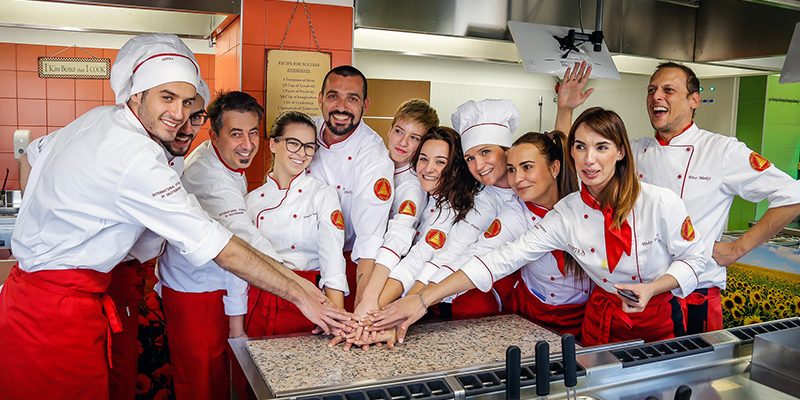
David Skoko is one of Croatia’s leading chefs. Known to the public for his appearances on the TV show “Jezikova juha,” he runs the Batelina family restaurant at Banjole near Pula, voted Croatia’s number one restaurant in 2014. When his gastronomy workshop for Aspira students was concluded, we took the chance to ask him a few questions.
Welcome to Aspira! What is it like to work with students? What are their impressions, and yours?
I recently decided to devote myself to teaching after I realized knowledge was worthless if I kept it to myself. I love the fact that there are people at Aspira who can receive this knowledge and apply it in their careers. I am very excited about that.
Have you ever worked with students before?
I have a few years of experience with the Agency for Rural Development of Istria, which deals with the promotion and protection of autochtonous Istrian products. The workshops I held for them were meant for professional chefs and other industry insiders. Working with students has many resemblances to this. Students already have some knowledge and experience with fine dining, so there is no need to start at square one. My wish is to convey ideas, a way of thinking about food, fish in particular. How to think creatively about the eating, promoting and branding fish.
Can fine dining provide the reason for a spike in weekend visits, especially from Croatia’s neighbors?
We certainly have the potential for it. We are a safe country, with good traffic connections; a big part of Europe is close to us. In order to achieve recognition on the European fine dining scene, we need to start appreciating local ingredients. I am not talking about ingredients resembling local ingredients. I am talking about what we really happen to have. We have plenty of excellent fish in our waters, but we don’t appreaciate this nearly enough. Visitors worth their salt will ask about the specifics of our land and sea fauna. When we are in France, we don’t want to eat Dutch cheese. Why would we settle for it in Croatia? Travellers wish to experience authentic food which characterizes the region they are visiting. This is where our hotels and restaurants fail. There is no chance for them to acquire local ingredients simply because they are not grown in sufficient quantities. In order for our fine dining scene to achieve a firmly based level of recognition, we simply must promote food production. We realized this ahead of the pack in Istria, and so we have been developing gastronomical tourism for a while now. Higher end establishments tend to be full even now, at the end of October. This is a result of collaboration with tourism boards and family farms.

Back to you. You have a great deal of experience. What would you say is your favorite place to work? Is it your family restaurant, Batelina?
The Batelina story has been going on for 18 years, with no intention of stopping. It’s a place where I have creative freedom, which for me is the number one thing. It looks like nothing much, but we put our heart and soul into every dish. We can ascribe much of our success to our enduring focus on quality local products. This is what makes us recognizable.
What matters most if you wish to become a head chef?
A quality head chef must be a good educator, because other team members will be at a lower knowledge and skill level. Thus, a head chef needs to be able to convey knowledge. Business skills are also a must, because a professional kitchen needs to make a profit. It is essential to always be continuing our personal as well as professional growth. Creativity is important, but it matters less than that outlook. The world’s cuisine is a source of endless inspiration, and there can be no justification for superciliiousness and complacence. A head chef must also be a psychologist, and an inspiration to others.

Did you always know you were going to be a chef?
No. I had the great good fortune of growing up on excellent food, entirely unaware that there was such a thing as bad food. My entire family loved to eat well very much. My mother and late grandma made it possible for all of us. When we started our own business with the simple idea of completely utilizing the day’s catch by the local fishermen, we realized that we were very good at making fish, better than the people around us at the time. This lucky circumstance made business success possible. A constant effort to better ourselves we came to the level where we are able to pull a fresh twist on each day’s catch, which actually varies very little. I personally travel around the world on the lookout for new ideas. I am always asking questions, learning and, if possible, applying this knowledge to the utilization of ingredients from my local area. I believe that specialization is of the utmost importance for a chef. I told you where my fish specialization came from. Many people can make lamb better than I can. Fish, they would have to try pretty hard.
Final message for Aspira’s students?
Focus your creativity on using whatever you can find near you. Wherever you are, do your research, what can be used commercially? This is the only way to make a name for yourself, and for our country to shine like a new star on the world’s fine dining map. Without this we lose our identity, and we’ve only had our country less for a little while!
